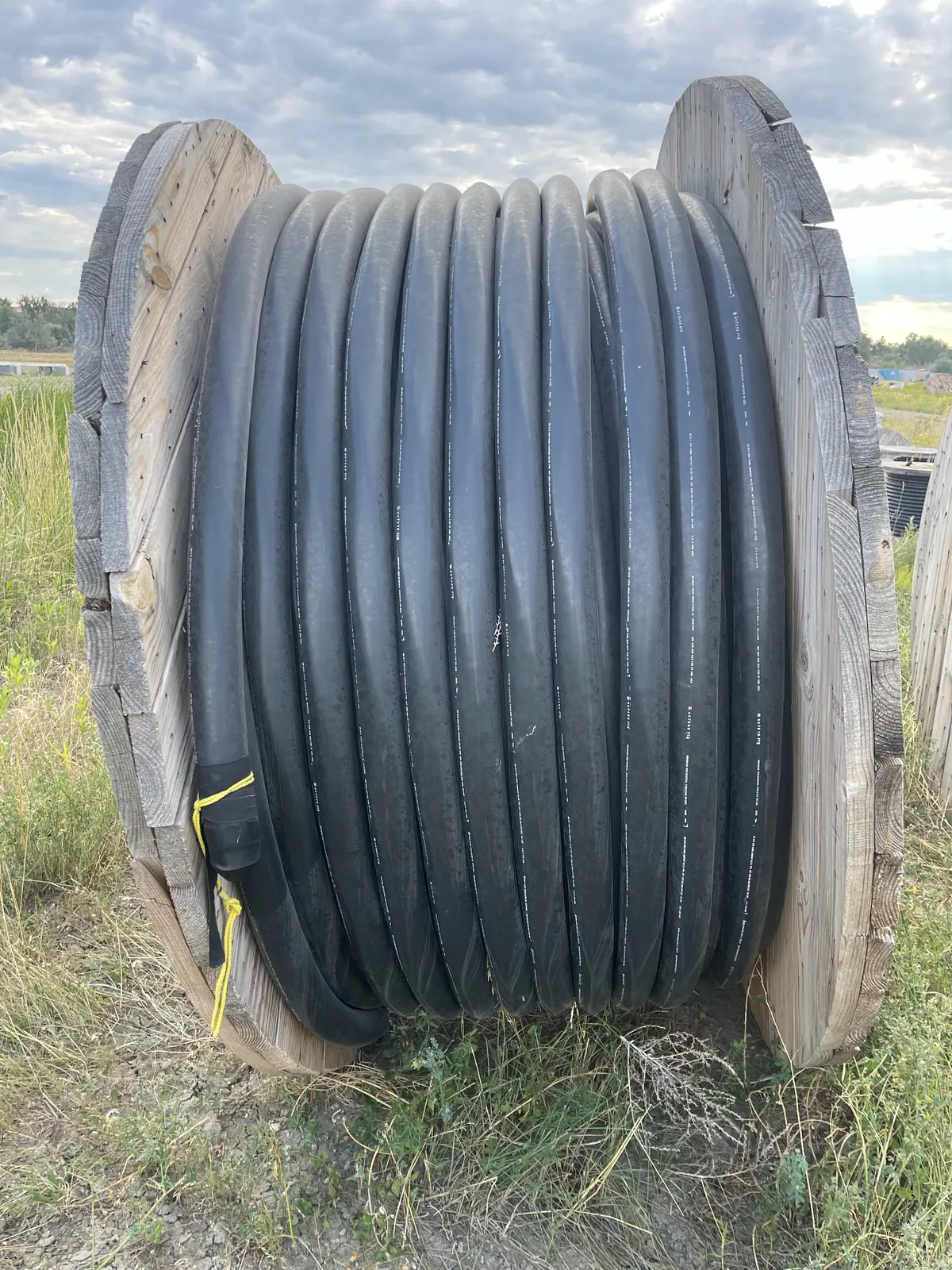
01How to Check How Much Wire Is Left on a Reel
Start with the reel tag and exposed jacket. Identify the manufacturer, cable designation, conductor size and any sequential footage marks before choosing a calculation method. A tag showing original shipment footage does not establish what remains after material has been pulled.
Use the strongest evidence available:
- Compare footage marks at both ends when accessible.
- Use net weight when you have a reliable scale and matching cable weight data.
- Use reel geometry when marks or useful weight records are unavailable.
Do not dismantle an unstable reel or reach into equipment to find the inner end. If that end is inaccessible, record what you can see and label the remaining footage as an estimate.
Our guide to reading a reel tag and jacket print explains which identification details to photograph. Keep those photos with your measurements so the estimate remains tied to the correct material.
02Use Sequential Jacket Marks When Both Ends Are Available
Some cables carry sequential length markings along the jacket. Confirm that the markings indicate footage rather than meters, manufacturing identifiers or another code. Read the numbers at the actual cable ends, not simply at convenient points farther along the jacket.
For a worked calculation, call the larger endpoint reading H and the smaller reading L. Remaining marked length is H − L, in the units printed on the cable. If the visible markings sit back from the ends, account for those unmarked tails separately.
This subtraction works only when both readings belong to the same continuous numbering sequence. Splices, joined lengths, restarted numbering or missing markings can make the difference misleading. Do not treat a single exposed number as the footage remaining on the reel.
Photograph each reading and enough surrounding jacket print to show the cable identity. Preserve the original readings alongside your calculated result.
03Estimate Remaining Footage from Net Cable Weight
The weight method divides cable-only weight by the weight of that exact cable per unit length. First subtract the empty reel and other packaging from the measured gross weight. An assumed tare weight can introduce substantial error, especially when the reel's construction or condition differs from your reference.
When the manufacturer's specification uses pounds per thousand feet, use:
Length in thousands of feet = net cable weight ÷ pounds per thousand feet.
For a worked calculation, let gross weight be G, empty reel and packaging weight be R, and the matching cable specification be P pounds per thousand feet. Net weight is G − R; estimated length is (G − R) ÷ P, expressed in thousands of feet.
Use finished-cable weight, including insulation, jackets, shields and other components where applicable. Our copper wire weight guide provides context, but bare conductor weight cannot substitute for a finished-cable specification.
04Estimate Cable Length on a Spool Using Reel Geometry
To estimate cable length on a spool geometrically, measure the occupied traverse width, wound cable diameter, drum diameter and cable outside diameter. Traverse means the width across the wound cable between the flanges; use the width actually occupied, not automatically the full available space.
Let T be occupied width, D wound diameter, d drum diameter, c cable outside diameter and p the packing fraction. With every measurement in the same unit:
Estimated length = p × T × (D² − d²) ÷ c².
The formula compares the wound annular volume with cable cross-sectional area and adjusts for air spaces. Without a defensible packing fraction, it gives only a rough volume-based estimate, not verified footage.
Flange diameter limits reel capacity but does not equal wound diameter on a partial reel. Review wire reel sizes and weights before confusing flange dimensions with the measurements this calculation needs.
05Work Through a Reel Footage Calculation
Consider a partial reel with an inaccessible inner end, a readable cable designation and a measured gross weight. The tag lists original footage, but some cable has been removed. Use the weight method rather than assuming the tag still describes the contents.
Record G for measured gross weight and R for verified empty reel and packaging weight. Calculate W = G − R. Find P, the manufacturer's pounds-per-thousand-feet figure for the exact cable construction, then calculate W ÷ P. Your answer is in thousands of feet, not individual feet.
Keep the input values and their sources with the result. If tare weight is uncertain, label the answer provisional rather than presenting it as measured footage.
A reel footage calculator is useful only when its inputs and units are correct. Use a geometry estimate as a cross-check, not as a reason to override stronger evidence.
06Check the Assumptions Before Reporting Footage
A precise-looking result can still come from uncertain inputs. Weight estimates fail when the specification describes a different construction, or when gross weight includes unaccounted packaging. Geometry estimates become less dependable with loose winding, uneven layers, flattened cable or changing outside diameter.
Before reporting a result, check:
- Whether the tag identifies the cable actually on the reel.
- Whether weight data covers the complete cable construction.
- Whether reel tare is measured or assumed.
- Whether dimensions describe the remaining winding.
- Whether markings use consistent units and numbering.
If methods disagree, investigate the inputs rather than averaging the answers. Record a supported range when uncertainty remains, and explain how you obtained it.
Estimated footage also says nothing by itself about suitability for installation. Keep that question separate from the quantity estimate; consult a licensed electrician or engineer for design and installation decisions.
07Use Your Estimate When Selling Surplus Wire in Houston
Send Houston Wire Buyers photos of reel tags and jacket print, estimated footage or weight, and the material's location. Include your calculation method and any uncertainty. We review the information, provide a written offer, schedule pickup or drop-off, verify material on site, and pay per the written offer.
Reusable wire is usually worth more than scrap value. Pricing also depends on conductor metal, type, demand, size, footage, packaging condition, manufacturer, date code, quantity and pickup logistics. Short, burned or heavily damaged material may be better suited to scrap; we will tell you what is reusable.
We serve Greater Houston only. Pickup takes place at the seller's site; drop-off at 6402 McGrew St in southeast Houston, near I-45 and I-610, is by appointment only. Call or text 951-403-5738 before visiting. Use Get an Offer to submit your details, and review our pickup information before scheduling.
FAQQuestions sellers ask
Can I estimate footage without unwinding the cable?
Yes. Weight and geometry methods can estimate remaining footage without unwinding the reel. Accessible endpoint markings may also help. Avoid pulling cable solely to improve an estimate if doing so could damage the material or destabilize the reel. State which method you used when submitting the quantity.
Does a reel tag's original footage count as proof of remaining length?
Not on a used partial reel unless reliable records establish that no cable has been removed. The tag is still valuable for identifying the material and locating manufacturer specifications. Describe original footage separately from your remaining-footage estimate so a buyer can distinguish the two.
Should I use conductor diameter or insulated cable diameter?
Use the outside diameter of the complete cable for a geometry calculation. Insulation, jackets and other layers occupy reel space along with the conductor. Conductor gauge alone does not establish finished outside diameter, so look for the manufacturer's specification for the exact product.
Can a calculator determine whether my cable is reusable?
No. A calculator estimates quantity; it does not evaluate damage, identification or condition. Provide clear photos of the jacket, exposed ends and reel packaging along with the calculation. Houston Wire Buyers focuses on reusable material and will tell sellers when wire appears better suited to scrap.
Can I request an offer if I only know the reel's weight?
Yes. Send the available weight, explain whether it is gross or net, and include tag and jacket photos plus your Greater Houston location. You can also email industrial832@gmail.com. Do not invent a footage figure to complete the request; identify what is known and what still needs verification.